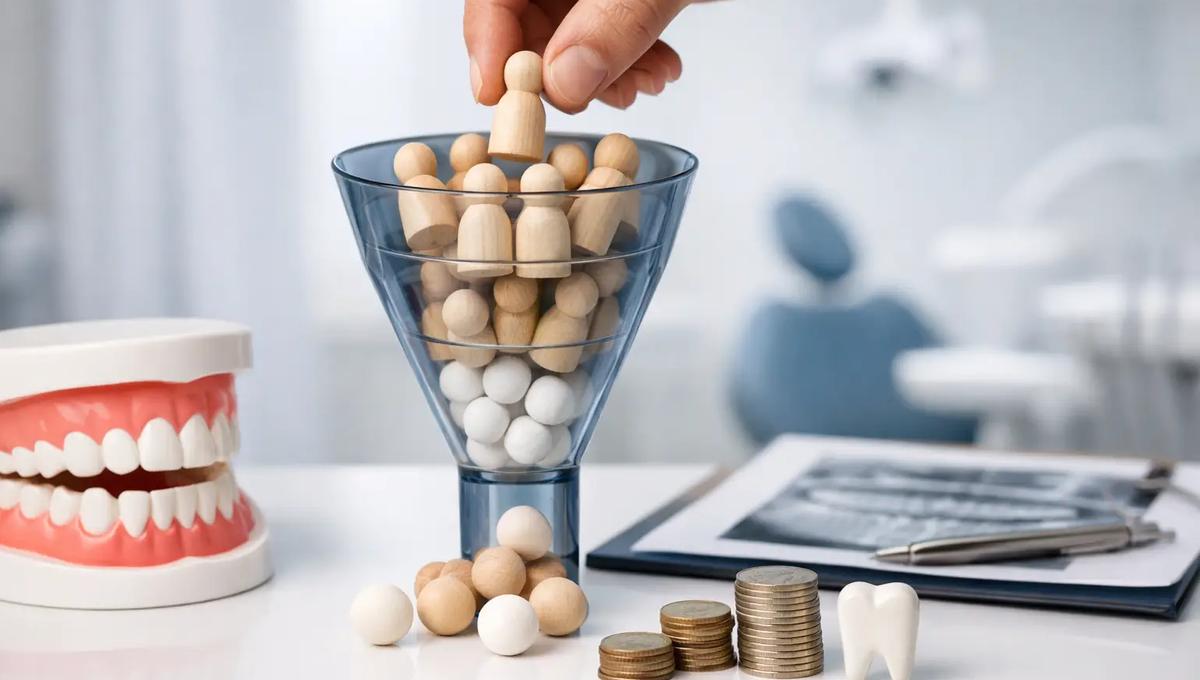
If your implant schedule feels light, the problem usually is not "marketing." It is math.
Most practice owners ask for more leads before they ask a better question: how many leads do dentists need to hit a real production goal? If you know your case value, consult rate, show rate, and close rate, the answer gets very clear very quickly.
That matters because elective dentistry is not a traffic game. It is a revenue-per-consultation game. A clinic doing implants or cosmetic cases does not need endless form fills. It needs enough qualified consultation opportunities to support a target number of starts at a profitable acquisition cost.
How many leads do dentists need?
The short answer is this: most implant and cosmetic clinics need enough leads to generate 15 to 40 qualified consultation opportunities per month if they want consistent growth. The exact number depends on your treatment mix, your average case value, your sales process, and how strict you are about lead quality.
For a general dentist focused on hygiene or basic restorative work, lead volume may need to be much higher because case values are lower. For an implant clinic closing full-arch or larger treatment plans, the lead number can be lower because each start carries more revenue.
That is why asking "how many leads do dentists need" without asking "for which procedure and at what close rate" leads to bad budgeting. A practice chasing veneer consults and a practice chasing full-arch cases are playing very different games.
Start with revenue, not lead count
The cleanest way to model lead demand is to work backward from your monthly production goal.
Let us say you want an additional $100,000 per month in implant production. If your average accepted case is $10,000, you need 10 starts. If your consult-to-start close rate is 25%, you need 40 attended consultations. If 70% of booked consultations actually show, you need about 57 booked consults. If 60% of raw leads turn into booked consults, you need roughly 95 leads.
That is the funnel. And every weak point in that funnel changes the number dramatically.
A practice with a stronger phone team, better follow-up, and better in-office sales process may only need 70 leads to produce the same outcome. A practice with slow response time and weak consult conversion may need 140. Same goal, very different lead requirement.
The numbers that actually matter
Most clinic owners track leads because it is the easiest number to see. It is also one of the least useful numbers on its own.
What matters more is lead-to-consult rate, consult show rate, consult-to-start close rate, and average case value. If even one of these is underperforming, your lead target rises and your cost per acquisition gets worse.
A simple benchmark model for elective dental campaigns often looks like this:
- 100 leads
- 55 to 70 booked consultations
- 35 to 50 attended consultations
- 8 to 15 starts
That range is wide for a reason. Lead source, offer, geography, speed to contact, and front desk performance all influence the outcome. Google search traffic tends to bring stronger intent but often at a higher cost. Meta can produce leads faster and cheaper, but qualification and follow-up matter more.
For implant and cosmetic practices, the goal is not to maximize cheap leads. It is to maximize profitable starts.
Why high-value clinics need fewer leads than they think
A lot of dentists overestimate the lead volume required because they think in terms of general practice marketing. Elective care works differently.
If your average implant case is worth $8,000 to $20,000, you do not need hundreds of new leads every month to move the business. You need a reliable stream of qualified prospects who are financially and procedurally aligned with what you offer.
This is where lead quality beats lead count. Fifty strong implant leads can outperform 200 mixed-intent leads who clicked an ad out of curiosity, asked about insurance, and never had real treatment intent.
That is also why ad strategy matters. A campaign built around broad awareness may generate activity without generating consultations. A campaign built around direct-response offers, procedure-specific creative, and a clear consultation CTA usually performs much better for clinics that care about booked calls and production.
How many leads do dentists need for implants vs cosmetic cases?
Implant campaigns and cosmetic campaigns usually behave differently.
Implant leads often involve a longer decision cycle, stronger financial consideration, and more no-shows if the follow-up process is weak. But when they convert, the economics are strong. That usually means you can tolerate a higher cost per lead and still win if your consultation process is tight.
Cosmetic leads, especially for veneers or smile makeovers, can book quickly but may shop more aggressively. If your sales process does not create urgency and trust fast, your close rate can slip even when lead volume looks healthy.
A practical monthly target for a growth-minded clinic might look like 60 to 120 implant leads or 80 to 150 cosmetic leads, depending on market competition and the strength of the offer. That is not a universal benchmark. It is a planning range. The right target is still driven by revenue goals and conversion performance.
The biggest mistake: buying leads to fix an internal conversion problem
More leads will not save a weak front desk.
If new inquiries are sitting untouched for 20 minutes, if calls are going to voicemail, or if treatment coordinators are not reactivating no-shows, your marketing math breaks fast. Clinics often think they need more volume when the real issue is that they are wasting the volume they already have.
Before increasing ad spend, check response speed, call handling, financing conversations, consult structure, and follow-up cadence. A small improvement in close rate often beats a large increase in lead volume.
For example, moving from a 20% consult close rate to 30% means you need one-third fewer attended consultations to hit the same number of starts. That is a major efficiency gain without changing traffic at all.
A simple formula to set your monthly lead target
If you want a working model, use this:
Required leads = desired monthly starts / close rate / show rate / booking rate
Here is a realistic example for an implant clinic:
You want 12 starts per month. Your close rate is 30%. Your show rate is 75%. Your lead-to-booked-consult rate is 65%.
12 / 0.30 / 0.75 / 0.65 = about 82 leads per month.
If those 12 starts average $9,000 each, that is $108,000 in production. Once you know that, you can judge ad spend properly. Spending $6,000 to generate those leads may be excellent. Spending $6,000 without knowing these numbers is just guessing.
What a healthy lead target looks like in practice
A healthy target is one your team can actually handle.
There is no value in generating 150 leads if your coordinators can only follow up properly with 60. There is also no value in running on 20 leads per month if your growth target requires 10 starts and your current close rate says you need four times that volume.
The right number sits at the intersection of demand, operational capacity, and return. It should feel commercially realistic, not emotionally comforting.
For many specialty-focused clinics, that means building toward a predictable baseline first, then scaling. Get to a level where consultation flow is steady, case acceptance is measured weekly, and patient acquisition cost stays in range. After that, increase budget with discipline.
That is the difference between a practice that hopes for growth and one that can plan for it.
At Booked.Dental, this is the lens we use because consult volume without economics is noise. Clinics do not scale from more impressions. They scale from a repeatable pipeline of qualified consultation calls that turn into high-value treatment.
If you are asking how many leads your practice needs, do not start with averages from other clinics. Start with your revenue goal, your case value, and your real conversion data. That is where clarity starts, and where wasted ad spend usually ends.
Ready to check if your market is available?
Pick a time to confirm whether your city is still open. Booked.Dental works with only one implant or cosmetic clinic per local market.
Check Your Market