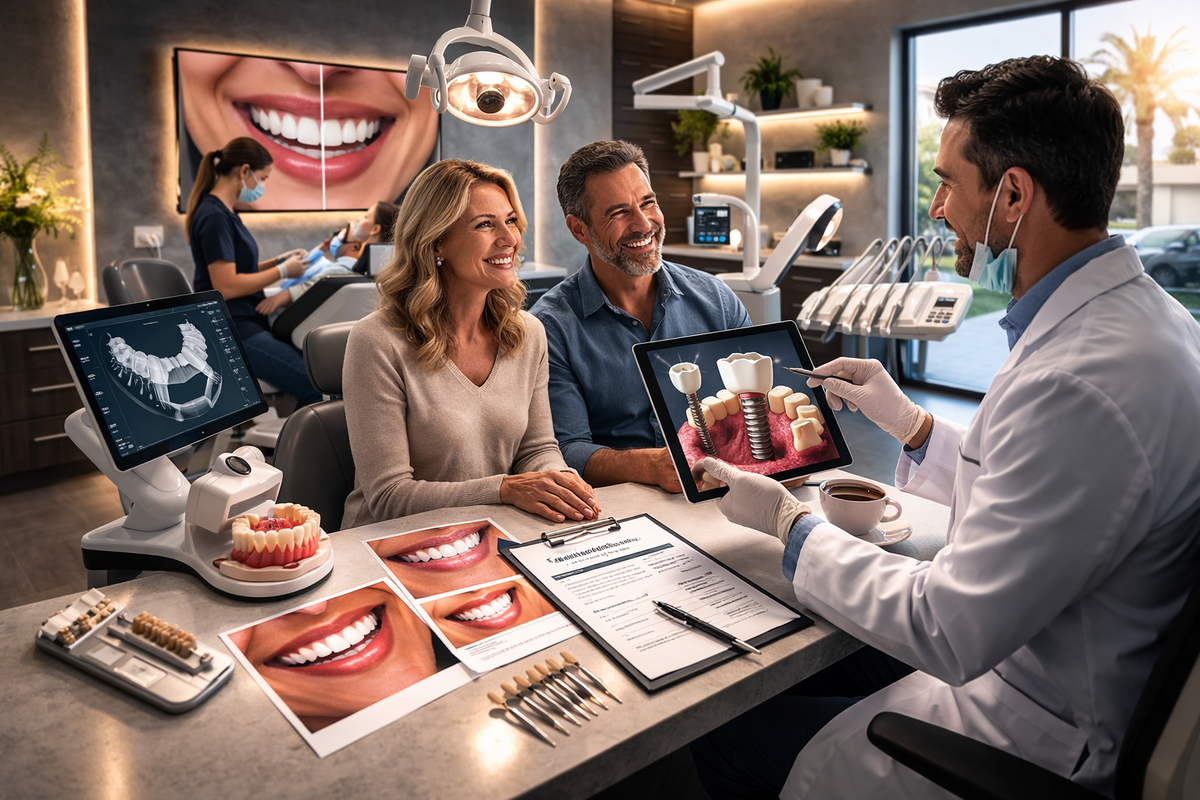
If your schedule is full of hygiene, emergencies, and low-ticket treatment while implants or cosmetic qualified opportunities come in waves, you do not have a lead problem alone. You have a case-mix problem. Clinics that book more high value cases do not rely on hope, referrals, or generic marketing. They build a patient acquisition system around intent, speed, and economics.
That matters because a practice can look busy and still stall. One full-arch case or a handful of veneer starts can outperform a month of low-margin production. If growth is the goal, marketing has to be judged by qualified patient opportunity volume, show rate, start rate, and revenue per booked opportunity - not clicks, impressions, or vague brand lift.
Why most clinics struggle to book more high value cases
The usual issue is not that there is no demand. It is that the clinic is using broad marketing for a narrow outcome. Implant and cosmetic patients do not convert the same way as someone looking for a cleaning or a same-day emergency visit. They need the right offer, the right message, and a clear reason to take the next step now.
A lot of practices still run one of two bad plays. The first is depending too heavily on referrals and organic traffic. That can work for a while, but it is not predictable. The second is paying for generic agency work that drives traffic without real purchase intent. You get leads that ask about price, disappear after one text, or were never serious candidates in the first place.
High-value dentistry is different because the patient decision is bigger. The treatment is more expensive, the emotional stakes are higher, and trust has to be built quickly. That means your marketing needs to qualify and persuade at the same time.
The real formula to book more high value cases
At a practical level, clinics that consistently book more high value cases usually get four things right. They target the right patient, use the right channel, present the right offer, and follow up fast enough to capture intent before it cools off.
Miss one of those and performance drops. You can have great ads, but if front desk follow-up is slow, qualified opportunities leak. You can have strong contact handling, but if the offer is weak, lead volume never gets off the ground. It is a system, not a single tactic.
Start with procedure-specific targeting
If you want more implant cases, market implants. If you want more veneer qualified opportunities, market veneers. That sounds obvious, but many campaigns are still built around the practice rather than the procedure. Patients are not searching for your office because your logo is attractive. They are responding to a problem they want solved.
For implants, the message should speak to missing teeth, loose dentures, confidence, and function. For cosmetic work, the message should focus on appearance, social confidence, smile dissatisfaction, and visible transformation. When the message matches the patient’s pain point, lead quality improves.
This is also where channel choice matters. Google Ads captures existing intent. Meta creates demand and interrupts attention. Both can work, but they do different jobs. Google is often stronger for patients already searching for a solution. Meta can be excellent for getting in front of people who qualify emotionally and financially but have not searched yet. The best mix depends on your market, your offer, and how quickly you need volume.
Your offer has to lower friction without cheapening the service
High-value cases are not sold on discounts alone. In fact, aggressive discounting can attract the wrong lead. But patients still need a reason to raise their hand. The best offers reduce perceived risk rather than slash perceived value.
For implants, that might be a free patient opportunity, free 3D scan, or a clear financing pathway. For cosmetic cases, it might be a smile design opportunity or a before-and-after driven evaluation. The point is to make the first step easy while keeping the treatment positioned as premium.
There is a trade-off here. If the offer is too soft, response can be slow. If it is too broad or too cheap, lead quality drops. Strong campaigns usually sit in the middle - compelling enough to drive action, tight enough to filter out casual shoppers.
Why ad creative matters more than most dentists think
A lot of clinics still run polished but generic ad creative. Stock-looking imagery, vague slogans, and broad claims about quality dentistry do not move elective patients to book. High-value procedure marketing performs better when the creative feels specific, believable, and immediate.
That is one reason UGC-style ads have become so effective. They feel less like a brand campaign and more like proof. A patient-style video, a doctor explaining candidacy in plain English, or a simple treatment outcome story can outperform overproduced creative because it gets to trust faster.
You are not trying to win a design award. You are trying to generate a qualified patient opportunity contact. In that context, clear beats clever almost every time.
Landing pages should book qualified opportunities, not impress peers
Once a lead clicks, the page has one job: convert interest into action. Too many clinic websites send paid traffic to a generic homepage with multiple navigation options, broad service menus, and no urgency. That is wasted intent.
A strong landing page for implants or cosmetic treatment should stay tightly aligned with the ad. The patient should see the same promise, the same procedure focus, and a short path to booking. Before-and-after visuals, financing cues, brief trust builders, and a simple form usually outperform long blocks of general practice copy.
This is another place where it depends. If your market is highly competitive, you may need stronger proof and more education on the page. If your brand already has authority locally, a shorter page can work. But in either case, clarity wins.
Speed is the difference between a lead and a lost case
Most clinics underestimate how fast intent fades. A patient who fills out a form for implants or veneers is rarely contacting just one office. If your follow-up happens hours later, or the next day, your close rate will suffer no matter how good the campaign is.
The clinics that book more high value cases treat every lead like a hot inbound opportunity. That means immediate outreach, multiple contact attempts, and staff who know how to move a prospect into a patient opportunity without sounding scripted or hesitant.
This is where many campaigns break. The ads work. The leads come in. But the office responds slowly, misses opportunities, or treats a $20,000 case inquiry the same way it treats a routine cleaning request. Marketing cannot fix weak lead handling by itself.
Your front desk needs a conversion script, not just availability
A high-value lead often has anxiety, price concern, and skepticism all at once. If the person answering the phone only gives basic scheduling info, that lead may never book. Staff need a simple framework for handling objections, reinforcing value, and guiding the caller to the next step.
That does not mean hard selling. It means confidence. The patient should feel that your office handles this procedure often, understands their concern, and can get them seen quickly. Even small changes in phone handling can materially improve booked opportunity rate.
Measure the numbers that actually predict growth
If you want a steady pipeline of implants or cosmetic qualified opportunities, stop judging performance by surface-level marketing metrics. A campaign with unqualified leads can still be a bad campaign. A campaign with higher lead cost can be the better investment if qualified opportunities and starts are stronger.
The numbers that matter most are cost per qualified lead, cost per booked opportunity, opportunity show rate, treatment acceptance, and revenue per start. Once you track those consistently, decisions get easier. You can see whether the problem is targeting, offer strength, sales follow-up, or close rate.
This is also how you protect ad spend. Instead of asking whether marketing feels busy, you ask whether it is producing profitable cases. That is a much better standard.
Predictable case growth comes from specialization
Elective dental marketing gets better when it is built around the economics of elective dentistry. Implant and cosmetic campaigns require different messaging, different creative, and different follow-up than general dental campaigns. That is why specialized execution tends to outperform broad agency work.
If your goal is to book more high value cases, the fix is usually not more random marketing activity. It is tighter targeting, stronger offers, better creative, and faster follow-up tied to the numbers that actually matter. The clinics that win in implants and cosmetic dentistry are not guessing. They are running a system that makes profitable qualified opportunities predictable.
The good news is that predictable growth does not require a massive budget or a long runway. It requires deciding that high-value case acquisition should be managed with the same precision as the dentistry itself.
Practical takeaways
What to do with this information
Judge the strategy by qualified opportunities, not by raw clicks, impressions, or unfiltered lead volume.
Connect the channel, creative, landing page, qualification result, show rate, treatment acceptance, and ROI before scaling.
If the campaign does not teach the ad platform which prospects become real patients, budget can drift toward easy but low-quality activity.
Clinic decision checklist
Before increasing budget or changing channels, check that the system is measuring patient quality rather than marketing activity alone.
- Does the prospect show intent for a high-value treatment such as implants, full-arch care, veneers, or cosmetic dentistry?
- Is there a clear way to filter urgency, location, treatment fit, and financial fit before the team spends time?
- Can the clinic see which campaigns produced real patient opportunities rather than only form submissions?
- Does the content explain the next step in a way that reduces fear and increases trust?
Frequently asked questions
How should a clinic use this guide on How to Book More High Value Cases?
Use it as a decision checklist: define which treatments you want to grow, what counts as a qualified opportunity, and which metrics prove the marketing is producing real patients instead of surface-level activity.
What is the most important metric after a lead comes in?
Cost per lead is only an early signal. The clinic should track reachability, qualification, booked appointment rate, show rate, treatment acceptance, and ROI from closed cases.
Should SEO, Google Ads, and Meta Ads be measured the same way?
They should all connect back to patient quality and ROI, but they create demand differently. Google captures active searches, Meta creates demand, and SEO supports research, trust, and local authority.
Ready to check if your market is available?
Submit your details to confirm whether your city is still open. Booked.Dental works with only one implant or cosmetic clinic per local market.
Check Your Market