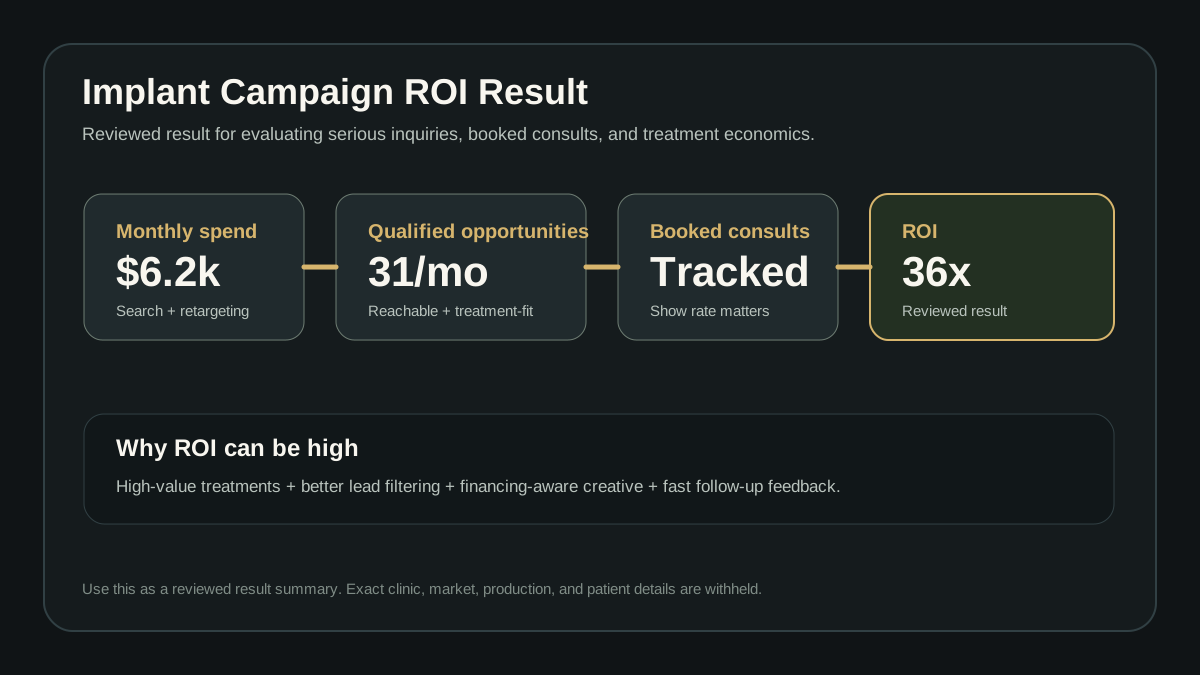
Implant Campaign ROI Example That Makes Sense

    Reviewed for E-E-A-T signalsUpdated and reviewed: March 17, 2026
    Dental implant model beside stacked coins and a hand using a calculator, with a growth chart arrow in the background.

    An implant campaign ROI example, without the fluff

    If a clinic spends $5,000 on ads and books six implant qualified opportunities, was the campaign profitable?

    A lot of owners answer that question too early. They look at cost per lead, feel good or bad about the number, and move on. That is usually where bad decisions start.

    For implant marketing, ROI is not judged at the lead level. It is judged at the case level. A cheap lead that never shows is expensive. A higher-cost opportunity that turns into a $15,000 treatment plan is not expensive at all.

    That is why a real implant campaign roi example has to go beyond clicks and form fills. You need to track the full path from ad spend to qualified opportunities, from qualified opportunities to starts, and from starts to collected revenue.

    The numbers that actually matter

    For implant and full-arch campaigns, the math is straightforward. The hard part is using the right inputs.

    At a minimum, a clinic should measure ad spend, number of qualified leads, qualified opportunities booked, qualified opportunities completed, cases closed, average collected revenue per case, and gross ROI. If any of those numbers are missing, your read on performance is incomplete.

    Here is the basic formula:

    ROI = (Revenue generated - ad spend - marketing fees) / total marketing cost

    Some practices prefer to calculate return on ad spend, or ROAS, which is simply revenue divided by ad spend. That can be useful, but ROI is the better business metric because it shows profit efficiency, not just top-line return.

    A realistic implant campaign ROI example

    Let’s use a simple monthly scenario for a US implant clinic running Meta and Google ads.

    The clinic spends $4,000 on ad spend and pays a $1,500 monthly management fee. Total campaign cost is $5,500.

    Over 30 days, the campaign generates 28 leads. Out of those, 16 are qualified enough to contact and book. The front desk books 10 implant qualified opportunities. Eight of those patients show up. Two accept treatment in the same month, and one additional patient starts treatment the following month after financing is approved.

    Now assign revenue.

    If the clinic sells single implant cases at an average collected revenue of $4,500, and two cases close this month, that is $9,000 in collected revenue. Using only same-month collections, the math looks like this:

    ROI = ($9,000 - $5,500) / $5,500 = 63.6%

    That is a positive campaign.

    But now let’s include the delayed third start that came from the same campaign. If that patient also becomes a $4,500 collected case, total attributed revenue rises to $13,500.

    ROI = ($13,500 - $5,500) / $5,500 = 145.4%

    Same campaign. Very different conclusion.

    This is where implant owners get tripped up. Implant treatment does not always close inside the same calendar month. If you judge performance too fast, you will often shut off campaigns that were working.

    Now look at the economics for larger implant cases

    The numbers become much stronger when the clinic is targeting full-arch or larger implant treatment plans.

    Take the same $5,500 total campaign cost. This time the campaign produces seven attended qualified opportunities, but only one patient starts a full-arch case worth $22,000 in collected revenue.

    The ROI becomes:

    ROI = ($22,000 - $5,500) / $5,500 = 300%

    That is why lead volume alone is a weak metric in high-value dental marketing. A campaign with fewer qualified opportunities can outperform one with better-filtered patient opportunities if the case value is materially higher.

    For implant clinics, the best campaigns often look less impressive at the top of the funnel than cosmetic or general dentistry campaigns. They may cost more per lead. They may generate fewer form submissions. But if they consistently produce qualified opportunities for treatment patients who can finance or self-pay, they win where it counts.

    Cost per lead is not the same as campaign efficiency

    A common mistake is treating cost per lead as the main KPI.

    Let’s say Campaign A generates 40 leads at $80 each. Campaign B generates 18 leads at $180 each. On the surface, Campaign A looks better. But if Campaign A produces only three attended qualified opportunities and no starts, while Campaign B produces six attended qualified opportunities and two implant cases, Campaign B is the only campaign that matters.

    The same issue shows up with agencies that optimize for cheap inquiries instead of qualified buyers. Implant marketing is not about collecting names. It is about generating patients who will actually book, show, and move toward treatment.

    That is why opportunity rate, show rate, and close rate carry more weight than raw lead count.

    What a good implant campaign should be judged against

    A campaign should be judged against your clinic’s economics, not someone else’s benchmark screenshot.

    If your average single implant case collects $4,000 and your close rate from attended opportunity to start is 25%, your campaign can tolerate a much different cost per opportunity than a practice selling full-arch cases at $20,000 with a 35% close rate.

    Here is the practical way to think about it.

    If one out of every four attended qualified opportunities becomes a $5,000 collected case, then each attended opportunity is worth $1,250 in expected revenue. If your cost per attended opportunity is $300, that is a strong margin. If your cost per attended opportunity is $1,100, the campaign may still work, but only if your collections, financing approvals, and close process are strong.

    This is why two clinics can run the same ad strategy and get very different ROI. The ad account matters. The front desk matters too. So does follow-up. So does case presentation.

    Why clinics misread ROI on implant ads

    Most underperforming implant campaigns are not failing in only one place. They are leaking at multiple points.

    Sometimes the targeting is too broad, so the practice pays for low-intent leads. Sometimes the offer is weak, so patients click but do not commit. In other cases, the ads work fine but the office takes too long to respond, books qualified opportunities too far out, or fails to confirm effectively.

    And then there is attribution. Many clinics count only the patient who says, "I saw your ad," while ignoring the patient who clicked an ad, searched the practice name later, and called from the website. Implant buyers often take more than one touchpoint before they book.

    If your reporting setup is weak, your ROI numbers will look worse than reality. That can lead to the wrong fixes.

    A better way to model expected return before you spend

    Before launching a campaign, estimate breakeven economics.

    Assume a monthly budget of $6,000 total. If your average collected implant case is $6,000 and your close rate from attended opportunity to start is 30%, each attended opportunity is worth $1,800 in expected revenue. To break even, you need about 3.4 attended qualified opportunities from that spend.

    That means if your campaign can reliably generate four or more attended qualified opportunities at that budget, the model works on paper. If your actual show rate or close rate is weaker, the budget may still be fine, but your internal process needs work.

    This is the right conversation for owners. Not "How many leads will I get?" but "How many attended qualified opportunities do I need to justify this spend?"

    What strong ROI usually looks like in practice

    A healthy implant campaign often has a few characteristics in common. The offer is clear. The creative speaks to a real patient problem. The landing flow is built to convert patient opportunity intent, not just curiosity. Response time is fast. Follow-up is structured. And reporting ties leads to qualified opportunities and starts.

    When those pieces are aligned, a campaign does not need heroic numbers to work. One or two quality implant starts can justify a month of spend. That is especially true for clinics with strong treatment acceptance and financing.

    This is also why niche operators tend to outperform generalist agencies in this category. Implant ads are not generic dental ads with different copy. The economics, objections, and patient qualification process are different. A clinic needs a system built around opportunity generation and case value, not vanity metrics.

    Booked.Dental is positioned around that exact idea - using Meta and Google as a direct pipeline for qualified implant and cosmetic qualified opportunities, with performance judged by revenue impact rather than activity.

    The right question to ask about ROI

    If you are reviewing an implant campaign, do not ask whether the lead cost looks good. Ask whether the campaign is producing attended qualified opportunities at a cost your case values can support.

    That is the standard.

    A real implant campaign roi example is never just an ad spend number next to a lead count. It is a chain of economics. Spend becomes leads, leads become qualified opportunities, qualified opportunities become starts, and starts become collections. If you measure that chain cleanly, your marketing decisions get simpler fast.

    The clinics that grow consistently are usually not the ones chasing the cheapest clicks. They are the ones that know exactly what a opportunity is worth, what a case is worth, and how much they can spend to acquire both with confidence.

    Practical takeaways

    What to do with this information

    Judge the strategy by qualified opportunities, not by raw clicks, impressions, or unfiltered lead volume.

    Connect the channel, creative, landing page, qualification result, show rate, treatment acceptance, and ROI before scaling.

    If the campaign does not teach the ad platform which prospects become real patients, budget can drift toward easy but low-quality activity.

    Clinic decision checklist

    Before increasing budget or changing channels, check that the system is measuring patient quality rather than marketing activity alone.

    • Does the prospect show intent for a high-value treatment such as implants, full-arch care, veneers, or cosmetic dentistry?
    • Is there a clear way to filter urgency, location, treatment fit, and financial fit before the team spends time?
    • Can the clinic see which campaigns produced real patient opportunities rather than only form submissions?
    • Does the content explain the next step in a way that reduces fear and increases trust?

    Frequently asked questions

    How should a clinic use this guide on Implant Campaign ROI Example That Makes Sense?

    Use it as a decision checklist: define which treatments you want to grow, what counts as a qualified opportunity, and which metrics prove the marketing is producing real patients instead of surface-level activity.

    What is the most important metric after a lead comes in?

    Cost per lead is only an early signal. The clinic should track reachability, qualification, booked appointment rate, show rate, treatment acceptance, and ROI from closed cases.

    Should SEO, Google Ads, and Meta Ads be measured the same way?

    They should all connect back to patient quality and ROI, but they create demand differently. Google captures active searches, Meta creates demand, and SEO supports research, trust, and local authority.

    Ready to check if your market is available?

    Submit your details to confirm whether your city is still open. Booked.Dental works with only one implant or cosmetic clinic per local market.

    Check Your Market
    Booked.Dental

    Teaching ads to find patients, not clicks.

    One clinic per market

    Check Your Market